PAROLE-Onco Implementation Guide
Interactive overview of the implementation guide
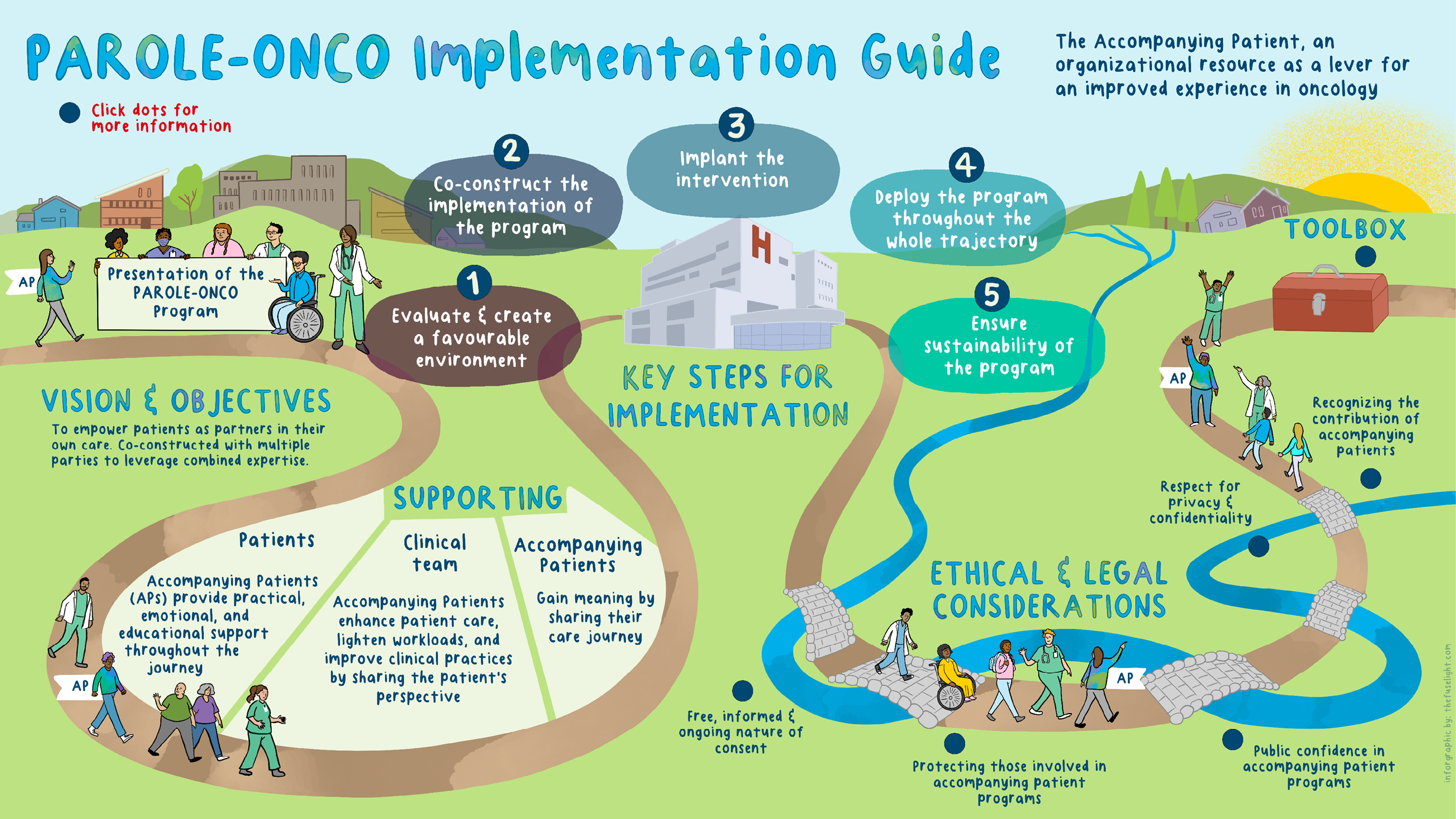

This implementation guide is intended for all health and social service institutions that wish to implement a peer-accompaniment (PA) program in oncology, or to evaluate and improve an existing program.
It was written more specifically for organizations in Quebec, but it can also be used elsewhere with some adaptations (elements specific to the Quebec context are identified in the guide).
It brings together the lessons learned and the tools developed during the implementation of PAROLE-Onco within the breast cancer care pathway.
Boîte à outils PAROLE-Onco
Introduction to the Partnership in Care and Services
Section 1: Introducing the PAROLE-Onco program
-
Testimonials from patients who have been supported
-
Testimonials from PA
-
PAROLE-Onco training
-
Presentation of the PAROLE-Onco program to patients by a healthcare professional (video by Dr. Fortin)
-
PAROLE-Onco capsule (women)
-
PAROLE-Onco capsule (men)
-
CHUM Report: Being supported through illness | Radio-Canada
-
« I saw it as a way to give back to the next person | TVA Nouvelles
-
PAROLE-Onco co-construction workshop - Example of PAROLE-Onco deployment in France
-
PAROLE-Onco self-supporting training
Section 2: Key Steps for a Successful Implementation of PAROLE-Onco
Step 1: Assessing and creating a favorable environment
-
PAROLE-Onco: What is it?
-
Introducing PAROLE-Onco program to managers and clinicians
-
Introducing PAROLE-Onco program to accompanying patients
-
Introducing PAROLE-Onco program to people affected by cancer
-
PAROLE-Onco brochure
-
PAROLE-Onco leaflet
-
Organizational readiness to implement change
-
PAROLE-Onco FRANCE co-construction workshop (example)
-
Perception of integration of accompanying patients questionnaire (Start)
-
Perception of integration of accompanying patients questionnaire (End)
-
Strengths, Weaknesses, Opportunities, Threats analysis (SWOT)
Step 2: Co-constructing program implementation
-
Support guide for Accompanying Patient’s in breast cancer (CHUM example) - French
-
Accompanying Patient’s Notes
-
Examples of S.M.A.R.T. objectives
-
Community of Practice for breast cancer accompanying patients Charter
-
Video: Le rôle de coordination des accompagnements (The role of accompanying patients coordinator)
-
Breast cancer pathway to receive support from an AP
-
Procedures for patient and AP meetings
-
Support Registry
-
Job description for AP coordinator
-
Selection criteria for users and APs
-
Project Charter example
Step 3: Implementing the intervention
-
Request for support from healthcare professionals
-
Information on PAC to be communicated to AP (+ example)
-
Participation and integration of APs in interdisciplinary meetings
AP questionnaires
PAC questionnaires
Questionnaires for healthcare professionals, senior management and managers
Interview and/or group discussion guides
-
Accompagnying patient logbook – code of conduct (CHUM example)
-
Registration form – volunteer patient partner (CHUM example)
-
Privacy policy (CHUM example)
-
Complaint filing process (CHUM example)
-
Legal and Ethical considerations
Step 4: Deploying the program along the trajectory
-
Example of inter-institutional collaboration for the benefit of patients
-
PAROLE-Onco video (women)
-
PAROLE-Onco video (men)
Step 5: Ensuring program sustainability
-
Legal and Ethical Considerations
-
Podcast: Who are patient accompanists, and what issues surround their status? with Catherine Régis and Marie-Pascale Pomey on H-podcast
Section 3: Ethical and Legal Considerations
ETHICAL CONSIDERATIONS
-
-
- Ensure that patients and PAs act within a moral, respectful framework.
- Build trust and transparency between patients and PAs.
- Protect the confidentiality of patients’ information.
-
LEGAL CONSIDERATIONS
-
-
- Provide a legal framework that safeguards the rights and responsibilities of all stakeholders.
- Ensure mechanisms for recourse in the event of a dispute.
- Offer legal protection for patients, PAs, and healthcare institutions.
-
This content has been updated on 24 septembre 2025 at 15 h 40 min.